Showing posts with label seed starting. Show all posts

Seed Starting Exposé!! Part III Hardening Off

For the third and final installment in the "Seed Starting Exposé" I'll try to not scare you.  This is, in short, the haaaard part. How to transition your tender sprouts in their seed trays to rough and ready young plants ready to be transplanted out into the wild. It's not easy and is the most likely place where you will end up frying your young recruits.  It's this phase that is the reason why plant nurseries are called nurseries.  These lil ones require near constant supervision as you transition them to the harsh realities of the outside world.  I'm not gonna pretend to be an expert at this phase and tell you how to easily get your sprouts ready for the real world in just 3 short days, but I will tell you that this phase is definitely more an art than a science.  I will tell you that no matter how 733T your indoor lights are, they are no match for direct sunlight so when you first move your recruits outside, set them in shade.  Next day or three, you can move on to dappled shade gradually working your way up to full sun.  The trick here is to keep them watered to the point where you don't cause dampening off (don't get the leaves wet once they have 2 true sets of leaves, water from the bottom) but keep them wet enough so that new root growth never dries out.  It's not easy to do.  The last few nights before you are ready to set them out into the ground, you want to drastically decrease the water you give them so that when you do put them in the ground and water them in, the transplants roots will sense the moisture in the real live soil you've planted them into and when they send roots out to try and get at that water the plant will be pleasantly surprised to find live soil and not potting mix that holds it.  You should be rewarded with a growth spurt once the transplant has sent roots out into the new living soil, a trick I like to use is to sprinkle a little earthworm castings into each transplant hole to give the new arrivals some food and energy to tackle setting up in their new house.
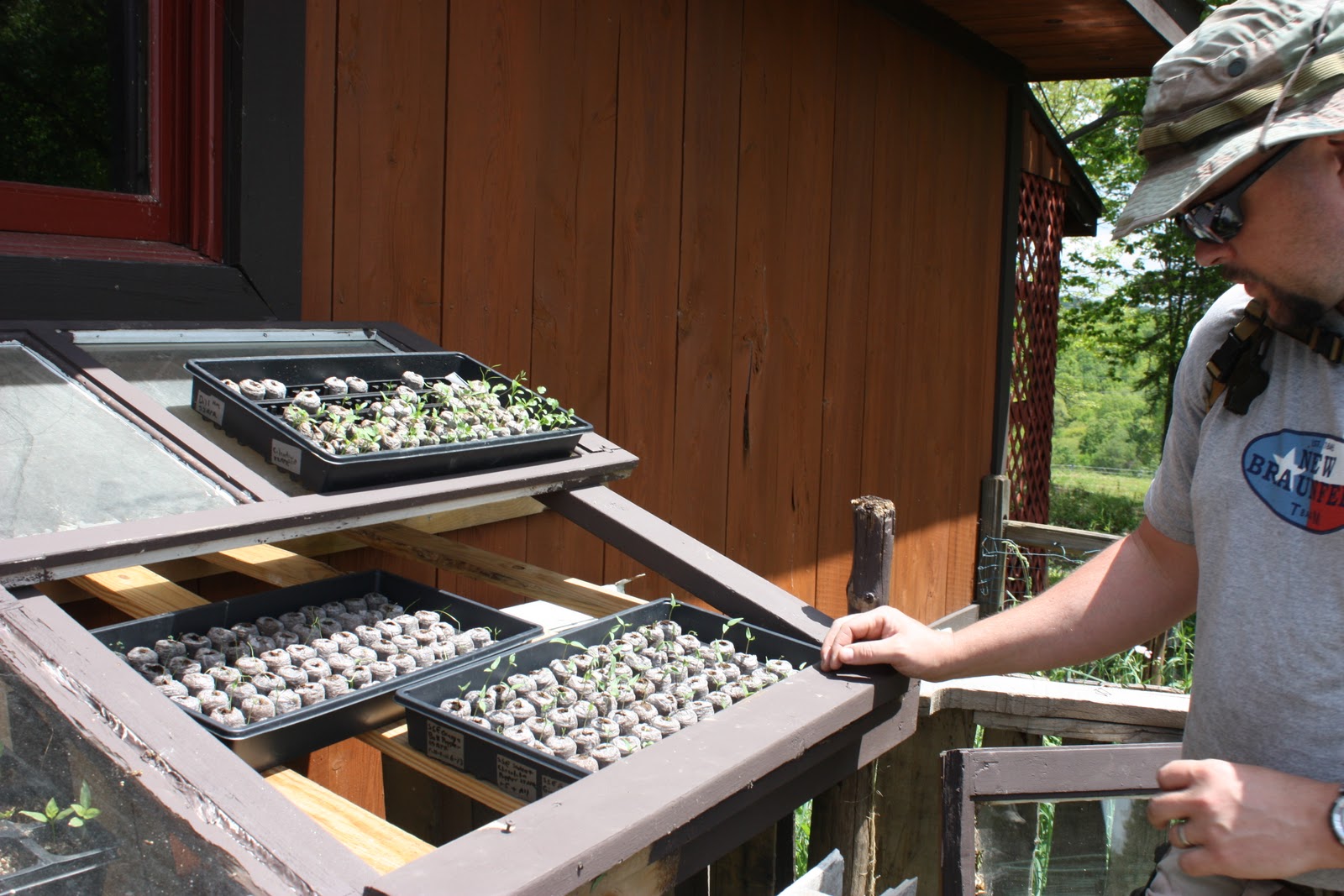
Here are some pics of a cold frame I built up against the side of the garage.  


Photos by Kristie Lawler

Read more...
Seed Starting Exposé!! Part I

It's spring. You have that packet of 'homemade heirloom tomato seeds' your Uncle Ebeneezer gave you for Christmas, you figure you oughta grow them (ProTip #239: Most seeds can/should be stored in an environment where "temp in degrees" + "rel. humidity in %" < 100, if you exceed those figures, say by storing them in an area where the temp. is 70F and the humidity is 40%, then you are degrading the "Germination Rate" or the % of seeds that will sprout when you put them in the ground) but you could use a few lil tips on seed starting.

This multi-part exposé on the secret world of 'Prop. Domes', 'Germ. rates', 'hot houses,' 'cold frames,' and 'hardening off' will help you get your seeds off to a strong start.

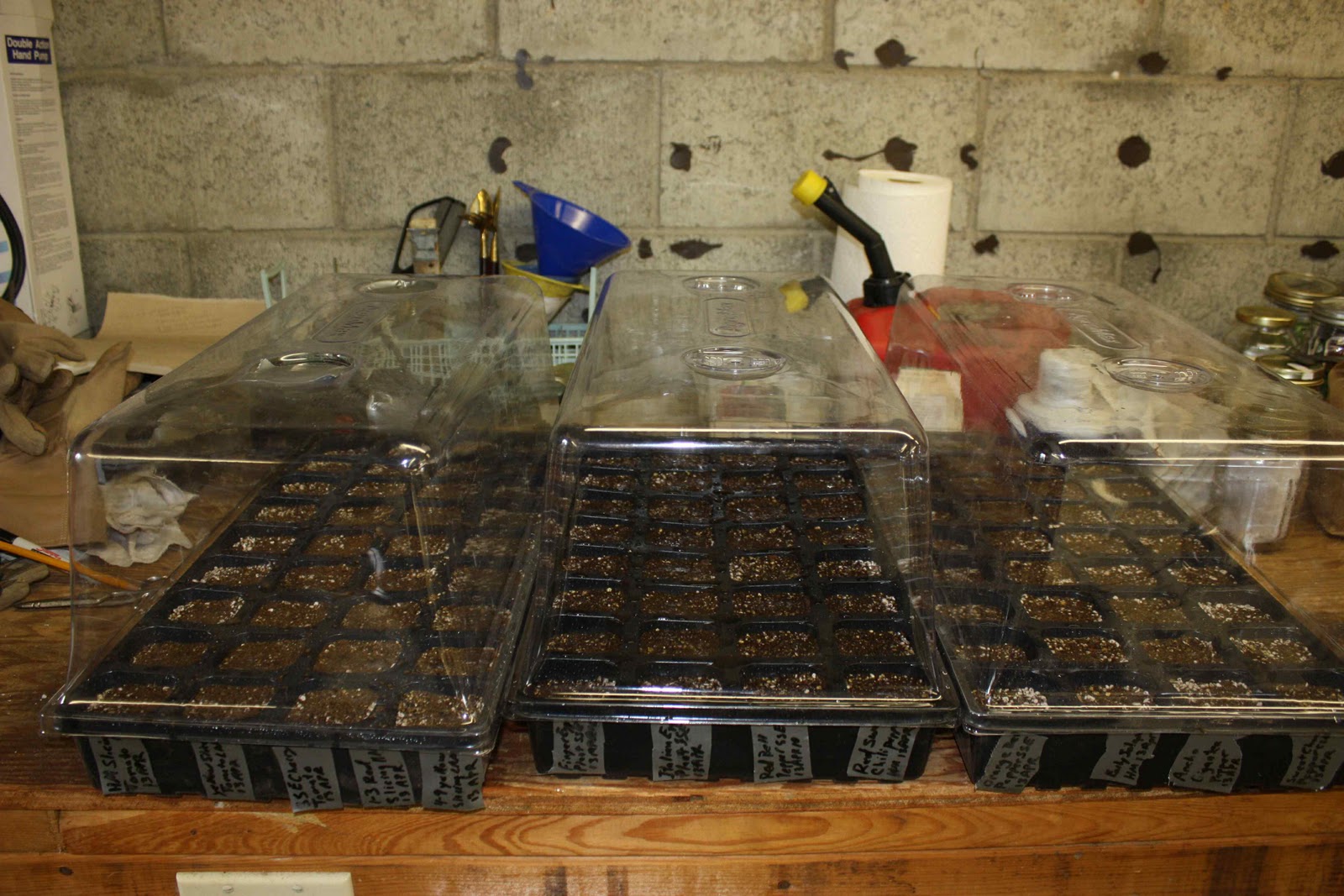
Propagation Domes
So, as mentioned above, you've been storing your seeds in a cold, dry, place for the last few months. If your Uncle Ebeneezer is of suspect character and you fear he might have given you some bum seeds in a diabolical attempt to destroy you, you can perform what is called a "Germination (Germ) Test" to determine what if any percentage of the seeds you put into the ground will actually come up.

Simply take 10 of the seeds, put them onto a paper towel, spritz them with some water, fold the paper towel over onto itself numerous times and moisten the paper towel to 'damp sponge' level then put the paper towel into a Ziploc bag, seal it, and place it in a warm place in your house (above the refrigerator is the old cliché place.)  Look up the 'days to germination' listed on the seed packet or online, and after the # of days +/- 1-2 days, open up the bag and see how many of the seeds sprouted. 7 out of 10 did? Your 'germination rate' is 70% meaning for every 100 seeds you plant in the field, you can expect 70 to sprout. Basically it's just a viability test to ensure that the seeds you are relying on are still good. In this economic environment where quality seed can be sparse and popular varieties can sell out months before the growing season, it would suck to be relying on your stash of 'super duper beet seeds' from 2005 to fulfill your beet needs for the upcoming 2011 season, plant them in the fields and have none of them come up then go to order more online and find out that 'super duper beet' seeds have been sold out for 3 months. FOILED!

What the little exercise above indicates is that for a seed to sprout, it needs, at a minimum, 3 things: X amount of moisture, X amount of thermal units, and seed to soil contact at a depth under the soil surface specified for that seed. Every seed has contained in it the energy required to sprout, drop a 'tap root' (basically a baby root system), push up a sprout, and develop its first set of 'true leaves.' After that it relies on the soil, water and photosynthesis for further growth.

Your mission when starting your own seeds for transplant is to supply the required environmental conditions needed to get the seeds into the 'vegetative growth stage' (the stages are basically: 1.Seed 2.Germination/sprouting 3.Vegetative Growth 4.Flowering 5. Fruiting).

So, to review, we've covered the basics of seed sprouting and how to make sure your seeds actually 'work,' or stage 1 of the 5 above.

In Part II we'll cover how to get through Stage 2--Germination.

Read more...

Labels

497 (2) agriculture solutions llc (1) agronomics (1) Ancho Poblano Peppers (1) apples (1) bamboo (1) barn cat (1) basil (1) beans (1) beans pics (1) bee keeping (1) bees (1) Benchmade (1) benchmade 806D2 (1) bio-char production (1) Blawnox (2) bok choi pics (1) bolting (1) Butternut Squash (1) chicken arc (1) chickens (4) chocolate zucchini cookies (1) chocolate zucchini muffins (1) cilantro (1) combat knife (1) compost (1) compost extract (1) compost tea (3) construction junction (1) contour farming (1) cover crops (1) cows (1) crockpot recipes (1) crop layout (2) crop plan (2) crop planning (4) dill (1) dora (1) Early Jalapeno Pepper (1) Echo SRM-230 review (1) Egg casserole (1) egg problems (1) eggmobile (1) eggplant (1) eggs (2) electric fencning (1) Farm family (1) farm irrigation (1) farm layout (3) farm overview (2) farm photos (1) farm stand (12) farm supplies (2) farmer grants (1) farmer veterans (1) farmer-veteran coalition (1) farmers market nutrition program (1) FAV-29 (1) fertilizer (1) field 502 (2) Field Day 2011 (1) field prep (5) field status (1) flash (1) food revolution (1) food systems (1) fruit trees (2) garlic (1) garlic planting (1) garlic scapes (1) green compost (1) green garlic (1) green manure (1) greens (1) ground hogs (1) growing peas in PA (1) hairy vetch (1) Happy New Year (1) heatwave in PA (1) heirloom melons (1) herb seedlings (1) homemade applesauce (1) homemade yeast (1) hops (2) hops in PA (2) how put down black plastic mulch (1) how to keep basil fresh (1) how to plant seedlings (1) humane chicken processing (1) Jamie Oliver (1) kale (1) Kale Recipes (1) Kubota (1) Kubota B2920 won't start (1) last average frost date western PA (1) legume plan (1) Listada de Gandia eggplant (1) local food movement (1) making yeast for bread (1) Meet the team (2) mint (1) moon and stars melon (3) mushrooms (1) naming conventions (1) new website (1) news (1) oats pics (1) Off-season (1) onion pics (1) online farm products (1) organic (1) organic fertilizers (1) paddock shift (1) perma-culture (1) Pingtung Long Eggplant (1) planting (3) plastic mulch (1) Polyface Farm (1) poultry netting (1) press release (1) Pro-Tips (5) produce handling (1) rainbow chard (1) Raw Kale Salad (1) recipes (6) red moon (1) rye (1) Ryobi Xpand-It (1) Sage seedlings (1) saving watermelon seeds (1) seed ordering (1) Seed plan (2) seed saving (1) seed starting (2) skunk (1) smarter not harder (5) soft shelled eggs (1) soil nutrients (1) soy beans (1) straight shaft trimmers (1) strip farming (1) swales (1) swiss chard (1) thai chili (1) Thanksgiving (1) Tool of the week (2) top bar bee hive (2) tractor safety (1) USDA FMNP (1) utility knife (1) watermelons (1) western PA drought (1) what do skunks eat (1) Worshops (1) yellow tomatoYellY (1) Zucchini (1)

  © Blogger template Shush by Ourblogtemplates.com 2009

Back to TOP